

EPF nominations decide inheritance -- here's what happens if you don't file.
In Part 6, we saw how EPF allows advances for housing, education, and medical needs during service.
But what happens if a member passes away before retirement? The answer lies in the EPF nomination and inheritance rules. These rules decide who receives the PF balance -- often the family's only financial cushion.
The importance of filing a nomination
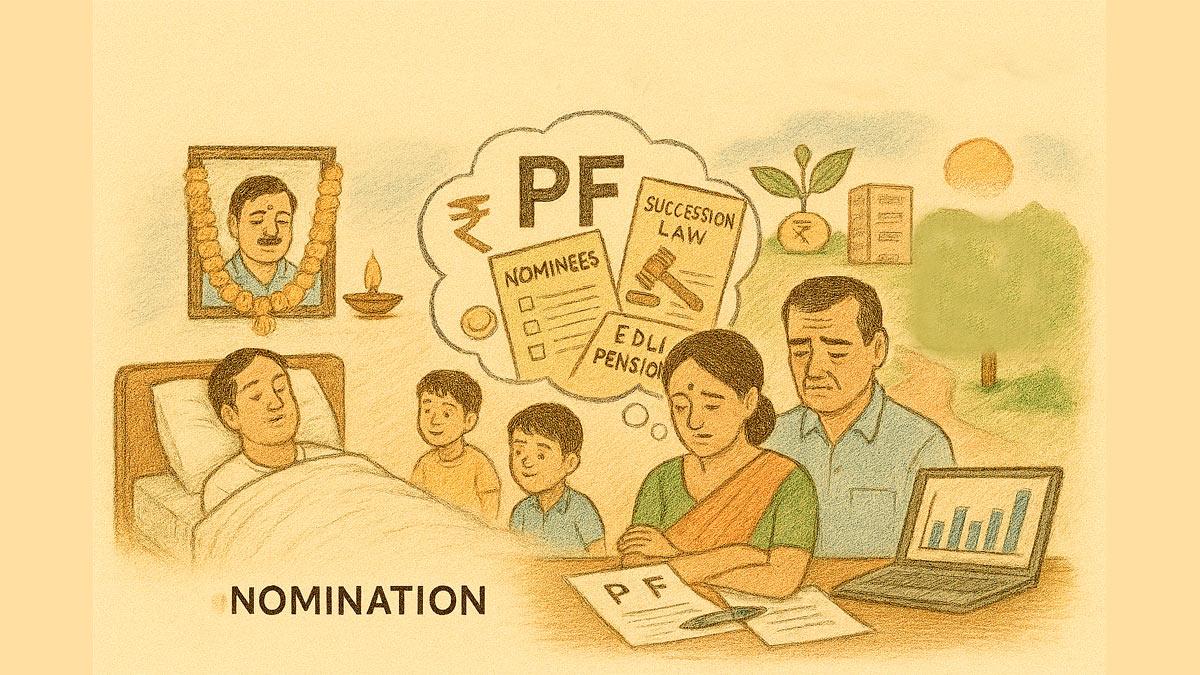
Every EPF member is required to file Form 2 (Nomination and Declaration Form), now done digitally through the UAN portal. The nominee receives:
- Employee's share + employer's share + accrued interest.
- EDLI (Employees' Deposit Linked Insurance) benefit, if eligible.
- Pension benefits for spouse and children under EPS-95, if service criteria are met.
Without a valid nomination, legal heirs may face delays and disputes. EPFO's 2023 circulars have repeatedly reminded employers to ensure members file nominations online.
(Source: EPF Scheme, 1952, Para 61)
Who can be nominated?
- If married: Only family members (spouse, children, dependent parents) can be nominees.
- If unmarried: Any person can be nominated, but once married, only family counts.
- Multiple nominees: Allowed, with percentage share distribution.
This restriction is rooted in protecting dependents -- a rule that has also been upheld by courts.
What if no nomination exists?
If a member dies without filing a nomination:
- PF is distributed among legal heirs as per succession laws.
- For Hindus, it follows the Hindu Succession Act; for Muslims, personal law; for Christians/others, the Indian Succession Act.
- This often leads to litigation when estranged spouses, second marriages, or dependent parents are involved.
Also remember that:
- Nomination ≠ ownership: Courts (e.g., Supreme Court, 2022, Ram Chander Talwar case) have clarified that a nominee is a trustee, not the absolute owner. Final ownership is decided by succession law.
- Practical outcome: Nominees can withdraw PF quickly, but ultimate legal heirs may later challenge and claim rights.
This legal nuance is why experts urge members to align EPF nomination with their will to avoid future disputes.
Online nominations and Aadhaar linking
Since 2021, EPFO has mandated e-nomination via the UAN Member e-Sewa portal. The process involves:
- Logging into UAN portal
- Updating family details
- Adding nominees and percentage allocation
- E-signing using Aadhaar OTP
Employers cannot approve or reject nominations; it's a direct link between member and EPFO.
Example: A family dispute avoided
Consider Ramesh, an EPF member who nominated his wife and daughter equally. On his untimely death, the PF balance of Rs 18 lakh was seamlessly split 50:50. Contrast this with his colleague Suresh, who had no nomination. His mother, wife, and brother filed competing claims, dragging the case into civil court for two years.
Why this matters for first-time readers
For many families, PF is the single largest lump-sum benefit received after a breadwinner's death. Filing a nomination ensures:
- Faster settlement
- Avoidance of legal battles
- Protection for the intended dependents
Part 1: Payslip To Pension To Long-Term Wealth: How EPF Works
Part 2: EPF Secrets Revealed: Where Your 12% Goes
Part 3: EPF@8.25%: Is It Really Worth It?
Part 4: How EPS Turns Part Of Your PF Into Lifelong Income
Part 5: EPF: How To Withdraw Smart, Protect Your Corpus
Part 6: Your EPF Can Fund Housing, Surgery, Education...
You can ask your personal finance questions to rediffGURUS HERE









 © 2026